#Diagnostics & troubleshooting
The ignition process begins when the engine's control unit sends a signal to the ignition coil to start spark formation. This signal causes an interruption in the flow of current through the primary winding. This causes a magnetic field to build up around the primary winding. The magnetic field collapses quickly when the control module abruptly cuts off the current.
It's important to note first that diesel engines don't have ignition coils. But essentially, the ignition coil's proper functioning is critical for the performance of internal-combustion engine vehicles.
One of the popular ways to critically determine how well an ignition coil pack is functioning is to test it, of course. While professionals usually perform this, it can also be done by individuals at homes with proper experience and knowledge.
Step-by-step: Quick ignition coil pack test
Always refer to your vehicle's owner's manual or consult a certified mechanic for specific repair details and safety procedures.
What's an ignition coil and how to test it?


TL;DR: The ignition coil is a small component that turns your car battery’s 12 volts into thousands, sparking the fuel that powers your engine. You can check it by looking for visible damage, testing resistance with a multimeter, or checking the spark with a spark tester.
Cars may feel effortless to drive, but behind that smooth ride is a network of parts working in sync. One of the smallest is the ignition coil – the piece that turns low battery voltage into the powerful spark your engine needs.
In this guide, we’ll cover what an ignition coil is, how it’s built, and why it matters. For those interested in DIY fixes, we’ll also go into common symptoms of failure and testing methods.
What's an ignition coil?
The ignition coil is an integral part of the ignition system in internal combustion engines. Its primary function is to transform the low-voltage electrical power from the car battery into the high-voltage electricity needed to create sparks in the spark plugs.
Note: There are two main engine types. External combustion – combustion happens outside the engine (like in a steam engine). Internal combustion – fuel burns directly inside the engine.
These sparks ignite the air-fuel mixture within the engine cylinders, initiating the combustion process that drives the engine's pistons and ultimately – powers the vehicle.
Ignition coils consist of two sets of copper wire windings and ferromagnetic (usually steel or iron) core. The primary winding is composed of thicker wire and carries the low-voltage current from the car battery, while the secondary winding is made of thinner wire and generates the high-voltage output.

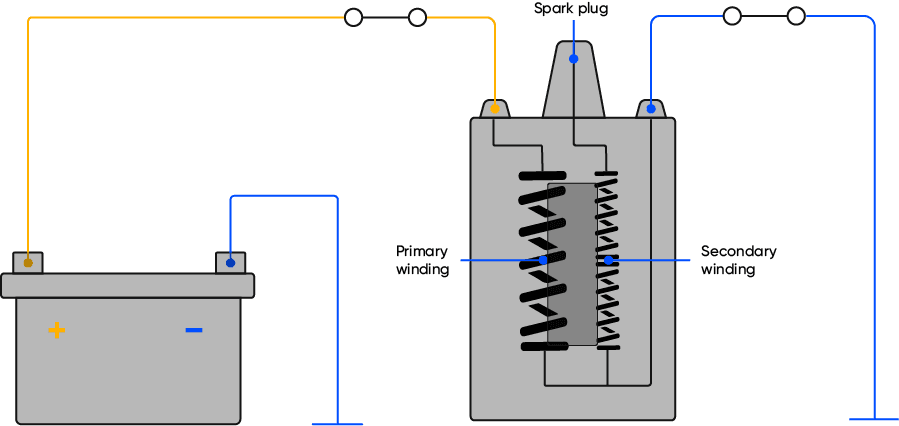
Basic circuit diagram of an ignition coil
How does an ignition coil work?
The ignition process begins when the engine's control unit sends a signal to the ignition coil to start spark formation. This signal causes an interruption in the flow of current through the primary winding. This causes a magnetic field to build up around the primary winding. The magnetic field collapses quickly when the control module abruptly cuts off the current.
This rapid change in magnetic flux induces a high voltage in the secondary winding through electromagnetic induction. The voltage produced can reach tens of thousands of volts, and travel to the spark plugs through spark plug wires.
As the high voltage jumps the spark plug gap, it ignites the air-fuel mixture within the cylinder, starting the combustion process. This is basically what happens when we turn the key to start the engine or press a dedicated button.
What are the symptoms of a faulty ignition coil?
It's important to note first that diesel engines don't have ignition coils. But essentially, the ignition coil's proper functioning is critical for the performance of internal-combustion engine vehicles.
A well-maintained ignition coil ensures that the spark plugs consistently generate strong and timely ignition, leading to efficient combustion and optimum engine power. However, as with any other mechanical part, over time, it can start to malfunction. If the ignition coil starts to fail, it can result in several issues like:
- Engine misfires – the engine may jolt or operate unevenly when you accelerate. Insufficient or weak sparks can lead to faulty combustion, resulting in reduced power, and increased exhaust emissions.
- Difficulty starting – a telltale sign is when a failing ignition coil can cause difficulties in starting the engine, especially during cold weather or after the vehicle has been parked for an extended period.
- Decreased fuel efficiency – inadequate ignition can lead to poor fuel economy, as the engine struggles to burn fuel efficiently.
- Check Engine light – your car's computer may turn on the Check Engine light if it detects an ignition issue.
Ignoring these symptoms can cause unburned fuel to damage the catalytic converter, a crucial emission control component.
Meanwhile, a well-maintained ignition coil ensures that the spark plugs consistently generate strong and timely ignition, leading to efficient combustion and optimum engine power. However, as with any other mechanical part, over time, it can start to malfunction. If you suspect your ignition coil is failing, it may be a good idea to run a test on it.
Types of ignition coils
Before we move on to instructions on how to test the ignition coil, let’s look at different types of ignition coils that you may encounter. Each of them have different configurations to meet specific design and performance needs.
Ignition coil pack with distributor
This older system uses a single ignition coil to generate high voltage that passes through a mechanical distributor to each spark plug. The distributor rotates in sync with the engine to ensure proper timing. While simple and easy to maintain, it's prone to wear and is less efficient at higher engine speeds.

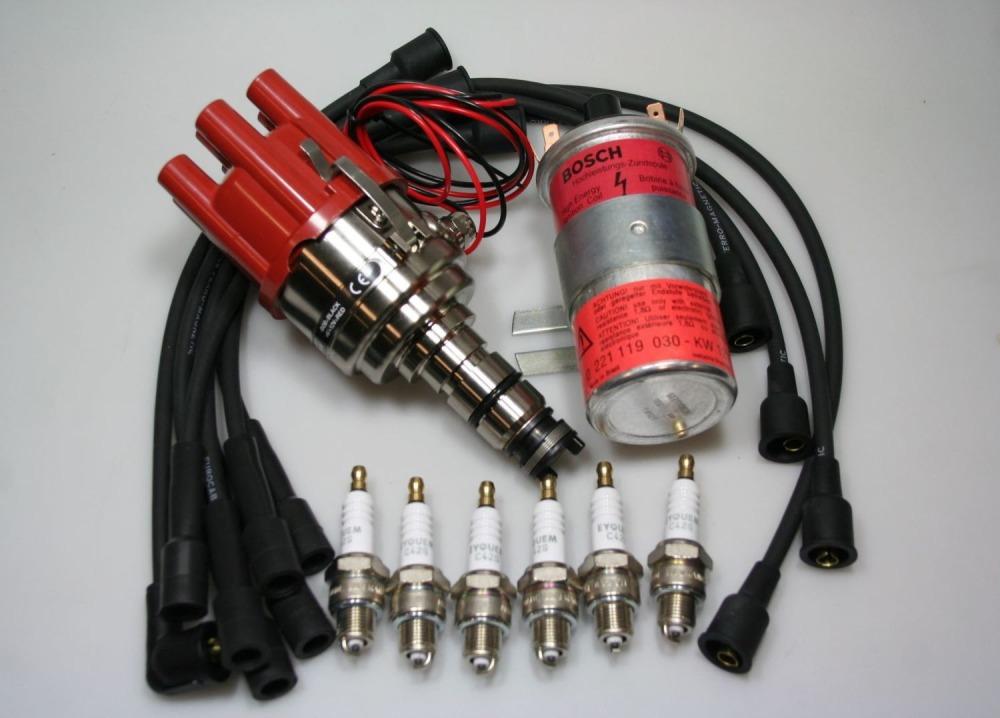
Ignition coil pack with distributor. Source: pat2d.com
Wasted spark coil pack
In a wasted spark system, the coil pack serves two cylinders at once, firing one spark for the combustion stroke and another "wasted" in the exhaust stroke of the paired cylinder.
This type uses a crankshaft position sensor for ignition timing, providing more precise control than a mechanical distributor. This setup improves reliability and performance.

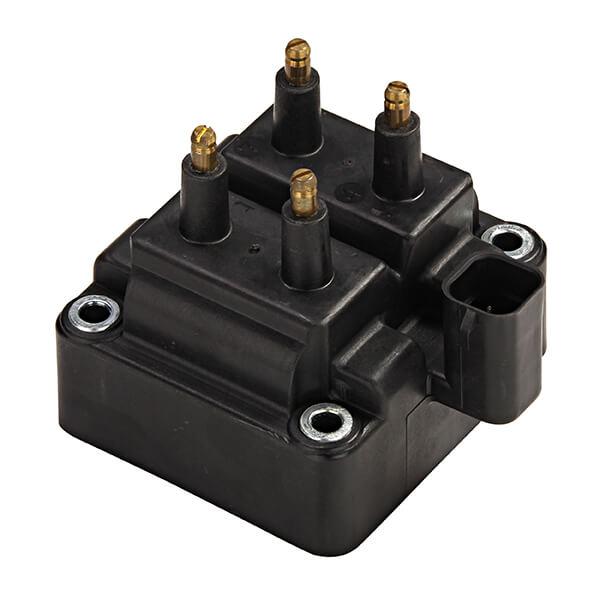
Wasted spark coil pack. Source: ngk.com
Coil-on-Plug (COP)
The coil-on-plug system places an individual ignition coil directly on each spark plug, allowing precise control of ignition timing for each cylinder. It eliminates the need for spark plug wires and improves performance, efficiency and durability. This advanced system is now standard on most modern vehicles for its superior reliability and energy efficiency.

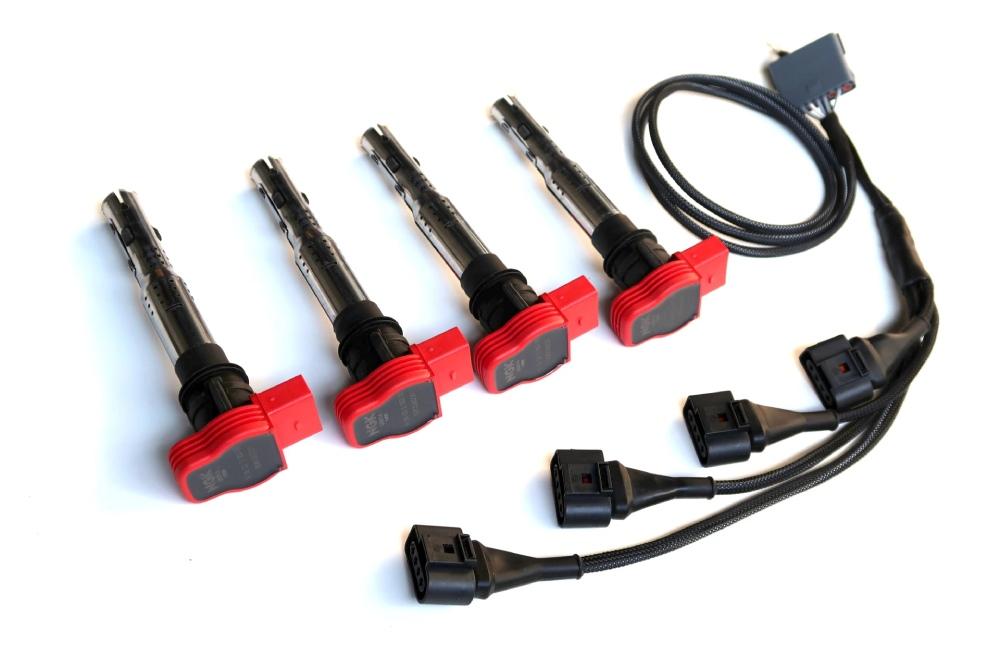
Coil-on-Plug (COP). Source: hummelink-modifications.nl
How to test the ignition coil pack?
One of the popular ways to critically determine how well an ignition coil pack is functioning is to test it, of course. While professionals usually perform this, it can also be done by individuals at homes with proper experience and knowledge.
This section will briefly review two test types that can help you determine whether something's wrong with your ignition coil.
Tools you’ll need for an ignition coil test
To test an ignition coil, gather these tools:
- The owner’s manual to locate ignition coils and check testing specs.
- A multimeter to measure resistance.
- Common hand tools such as socket wrenches and screwdrivers.
For deeper diagnostics, you may also want:
- An OBD-II scanner to read fault codes linked to ignition problems, such as our OBDeleven 3.
- An oscilloscope to analyze the coil’s voltage output in detail.
- A spark tester.
Step-by-step: Quick ignition coil pack test
Step 1: Locate the ignition coil and look for visual damage
In most modern cars, there's an ignition pack for each cylinder. They’re usually located above the engine and can be easily accessed. In most cases, they’re covered, so you’ll have to remove the front cover to access the ignition coil pack from a cylinder.
When located, check for cracks, burn marks, corrosion, or areas where the plastic has melted. Also, examine the wiring and connectors, since damage there can cause the coil to fail, and you’ll need to replace it.
Step 2: Power balance test.
When located, check for cracks, burn marks, corrosion, or areas where the plastic has melted. Also, examine the wiring and connectors, since damage there can cause the coil to fail, and you’ll need to replace it. You can do this by turning on the engine and disconnecting an individual ignition coil.
If you hear a decrease in RPMs, it means the ignition coil on that cylinder is working correctly and at full capacity. However, if you disconnect an ignition coil and don't hear any difference, the coil is malfunctioning. You may also see the check engine light come on. Continue to test all other coils the same way.
If visual inspection and the power balance test don’t reveal the problem, but you still notice symptoms or see diagnostic trouble codes, then the next step is more detailed testing. You can do it using tools like an OBD-II scanner or multimeter if you're skilled, or by taking the vehicle to a qualified mechanic for a professional diagnosis.
A more detailed test
Step 1: Make sure your vehicle is turned off and access the ignition coil pack. Once you open the front hood, locate the ignition coil pack, and depending on your vehicle's make and model – remove the front lid covering the packs.
Step 2: Remove the ignition pack. Once you can access the ignition pack, remove the side screws, which will immediately let you remove the whole pack.
Step 3: Run a resistance or ohms reading test (with a multimeter). Locate the harness connector on the ignition coil pack you’ve just removed. These connectors usually have three terminals.
Step 4: For this test, you'll need terminals 1 and 2. The best practice to locate the correct terminals for your specific car is to either do a Google image search or consult your technician.
Step 5: Finally, when you touch the terminals, the multimeter should display a reading above 0. Otherwise, it would mean that the ignition coil pack is in bad shape. Do the same with all other ignition coil packs.
Step 6: If the multimeter readings are good, try checking if the ignition coil can actually produce a strong spark by running a spark test.
If resistance or spark readings show issues, it may be time to replace the ignition coil. But if the coil checks out and problems remain, the culprit could be elsewhere – and a good OB2 scanner or a visit to a repair shop can help you get to the bottom of it.
Summing up
Ignition coils may be small, but they play a major role in delivering the high voltage needed for proper combustion.
Timely inspection and testing can catch a failing coil early. This helps prevent misfires and lowers the risk of further damage. Whether you handle it yourself or rely on a professional, staying on top of coil health will save you from costly repairs and keep your vehicle running smoothly.
Disclaimer: Advice, how-to guides, and car care tips on our blog are intended as helpful resources for general maintenance and repairs. While we strive for accuracy, the information is provided to the best of our knowledge and should be used at your own discretion and risk.
Always refer to your vehicle's owner's manual or consult a certified mechanic for specific repair details and safety procedures.

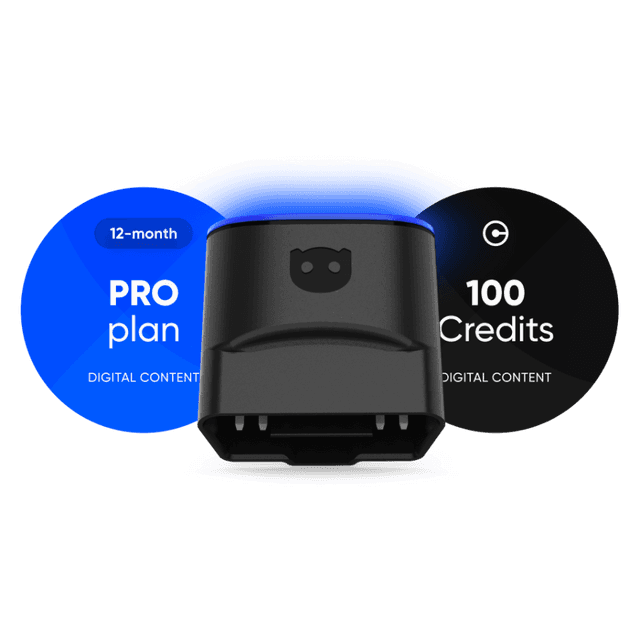
OBDeleven 3 PRO Pack + 100 Credits
Includes OBDeleven 3 device, PRO plan (12-month), and 100 Credits for unlocking car features with One-Click Apps
€139.99