#Maintenance
How to check your car’s hybrid battery


TL;DR: You can do quick, regular hybrid battery checks with your OBDeleven device to track your Toyota’s or Lexus’ health and help prevent early degradation (if timely fixes are done).
Hybrid batteries are built to last. Until one day your Prius dashboard turns into a light show, and the battery cooling fan sounds like a jet engine.
On the bright side, battery problems can be minor and easily prevented in some cases. With the right tools, you can spot early warning signs and understand your hybrid battery’s condition before it all goes south.
Here’s how to check your hybrid battery, what the results actually mean, and how OBDeleven can help you do that in minutes.
Why checking a car’s hybrid battery is important
If you own a hybrid, the battery plays a major role in how your car drives and how much fuel it uses.
As the battery ages, performance usually declines gradually. Even so, most hybrid batteries are generally designed to last 80,000–100,000 miles, or 130,000–170,000 kilometers. For many drivers, that works out to a solid seven to 14 years, depending on climate and driving habits. With proper care, that lifespan is generally realistic.
Keeping that timeframe in mind, regular checks can help you avoid some of the sudden “Check hybrid system” warnings. More importantly, they let you catch early issues like battery imbalance, overheating, or cooling problems before they cause serious damage and lead to a full battery replacement.
Plus, this matters even more when buying a used hybrid. Knowing the battery’s exact condition can help you avoid a lemon or factor repair/replacement costs into the price.
Most common hybrid battery problems
Here are the most common hybrid car battery issues, grouped by how difficult they are to fix.
Generally easy to solve:
- Overheating – often caused by poor airflow. Cleaning the fan, clearing vents, or replacing a faulty sensor can resolve it in most cases.
- Sensor or wiring issues – a bad sensor or damaged wire can trigger warnings even if the battery is fine.
- Early battery cell imbalance – if caught early, improving cooling and monitoring can help with damage control.
More serious:
- Advanced battery cell imbalance – may require reconditioning or module replacement.
- Capacity loss – as the battery ages, energy storage drops permanently. Severe loss often leads to repair or replacement, and this one is unavoidable.
- Repeated overheating damage – heat-damaged cells usually cannot recover, and failure accelerates over time.
The earlier you catch these issues, the simpler – and usually cheaper – the fix. That’s why running regular diagnostics to check for fault codes, not only in the battery but across all vehicle systems, is so important.
Pro tip: We’ve prepared a detailed list of common Toyota & Lexus issues and troubleshooting tips, including the P3000 code, which can signal an HV battery malfunction.
What a hybrid battery check tells you
A proper hybrid battery check looks at how the battery behaves internally, measuring two important things – battery balance and battery temperature.
Battery balance (ΔSoC) shows how even individual battery modules charge and discharge. Large differences between modules can signal early battery degradation. This means the battery may wear out faster and can trigger system faults if ignored.
Battery temperature, on the other hand, is important because hybrid batteries are sensitive to heat. High or uneven temperatures can accelerate wear and reduce, usually pointing to cooling problems.
How to check your hybrid battery with OBDeleven
OBDeleven lets you check your hybrid battery yourself – without visiting a workshop. The Hybrid battery check feature is designed specifically for Toyota and Lexus hybrid vehicles.
It pulls the right data through the OBDeleven device to give you a clear, detailed diagnosis. To get started, you’ll need an OBDeleven device, the OBDeleven mobile app, and a compatible Toyota or Lexus hybrid.
How it works
2. Open the OBDeleven app

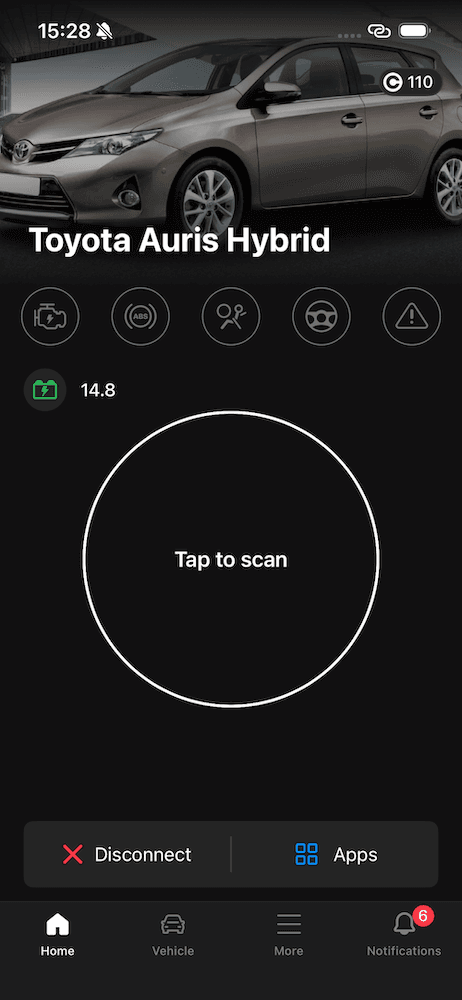
3. Navigate to the Vehicle section
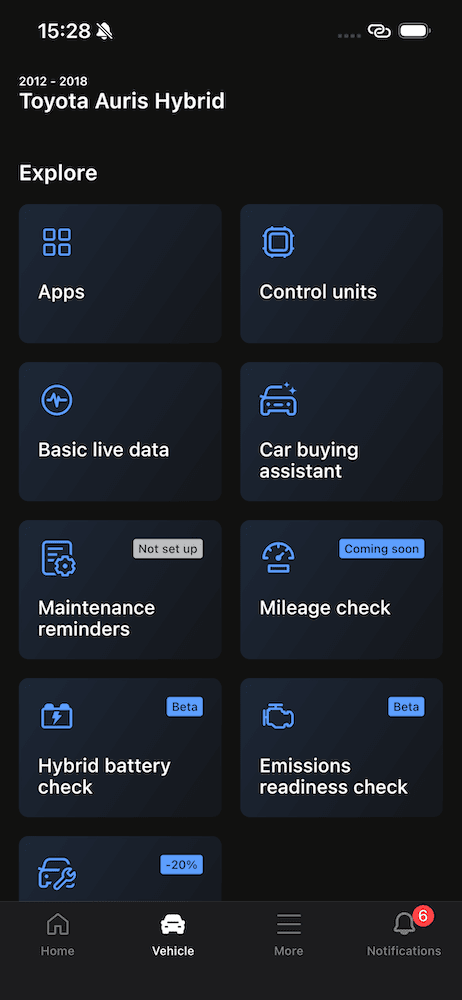
4. Click on Hybrid battery check tile
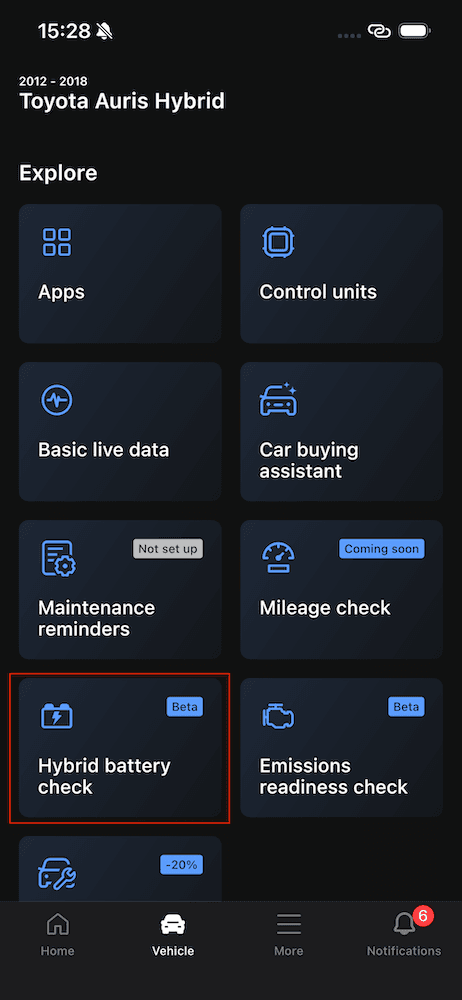
5. Start battery check and wait for the results
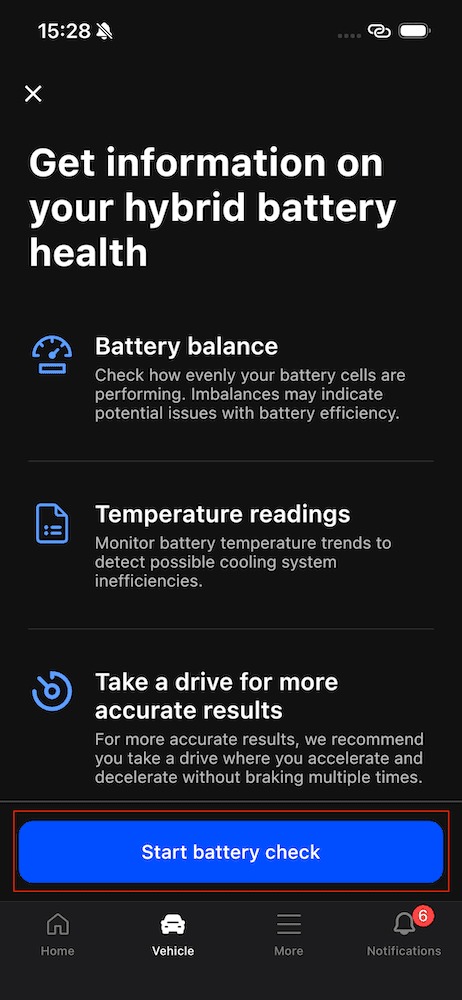
The process takes just a few minutes. For the most accurate results, we recommend taking a drive prior where you accelerate and decelerate without braking multiple times.
After the check, OBDeleven shows:
- Battery balance (ΔSoC) – the smaller the difference, the more evenly the battery operates.
- Battery temperature – the higher it is, the greater the risk of overheating, damage and reduced battery lifespan.
- A clear summary of overall battery health.
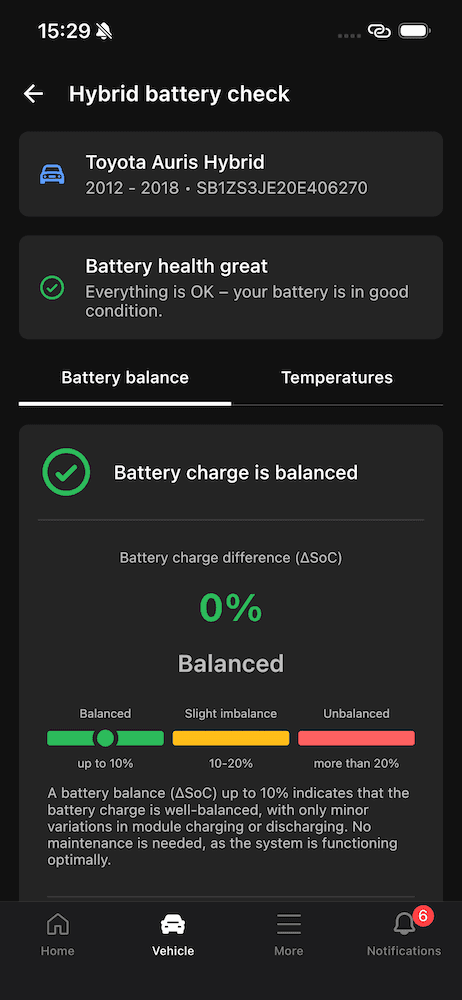
All results are presented in a way that’s easy to understand, even if you’re not a technician. For battery balance, you’ll get a status showing whether it’s balanced, slightly imbalanced, or unbalanced. For battery temperature, you’ll see whether it’s optimal, elevated, or overheating.
Hybrid battery check is available with OBDeleven 3 and OBDeleven 2 (NextGen) devices. For a more in-depth guide on how to interpret the results, read more in our What is Hybrid battery check FAQ.
Note: The Hybrid battery check feature is currently in beta and continues to be improved for accuracy and coverage.
Other ways to check your hybrid battery
There are several ways to check your hybrid battery, though many require specialized tools and equipment for a detailed assessment.
You can use a standard OBD scanner to manually read OBD live data and diagnostic trouble codes. However, OBDeleven simplifies this process by providing a convenient, one-click summary solution that makes battery health insights quick and easy to understand.
It’s also helpful to monitor long-term trends, such as fuel efficiency and the vehicle’s onboard energy flow or battery display. Sudden changes in these metrics can indicate potential battery degradation.
If needed, you can always have your hybrid battery inspected professionally by a hybrid battery specialist or dealership. They can perform a visual inspection for physical damage or corrosion, as well as electrical tests at a higher level. This is especially recommended if your OBD scan shows severe or persistent issues that cannot be resolved through basic fixes.
For regular diagnostics, a good OBD scanner like OBDeleven can save you a lot of money in the long run, as diagnostic fees at workshops can range from $75 to as much as $255.
How often should you check your hybrid battery?
There’s no strict rule for how often to check your hybrid battery, but every few months is a good starting point – especially if you already have an OBDeleven device.
It’s also important to check the battery when buying or selling a hybrid vehicle, or if you notice reduced fuel economy, rapid charge swings, the battery rarely reaching full charge, or the petrol engine running almost constantly even at low speeds.
A cooling fan that runs loudly or continuously can also signal a potential issue and should be inspected early. If you see a “Check hybrid system” or “Check engine” light, a full vehicle diagnostic, not just the battery, is strongly recommended.
Final thoughts
At the end of the day, your hybrid battery is one of the most important – and expensive – parts of your car.
A quick check now and then gives you peace of mind and helps you catch small issues before they turn into costly problems. Use OBDeleven to simplify the process and keep your Toyota or Lexus running smoothly and saving you fuel for years to come.

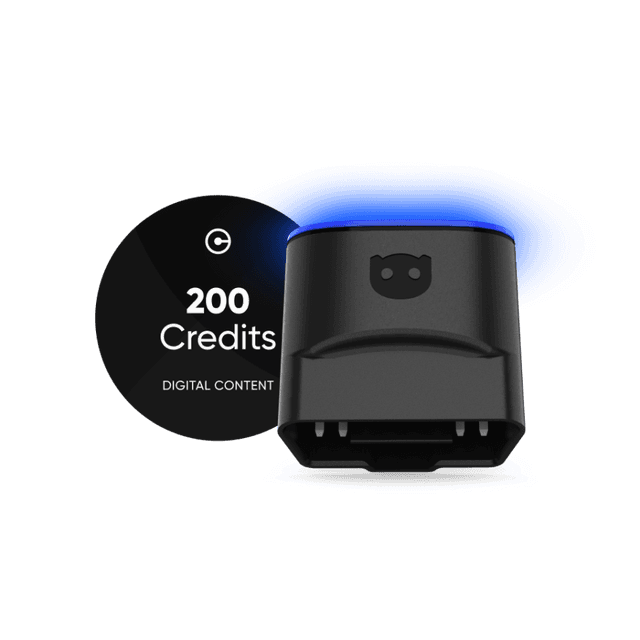
OBDeleven 3 device + 200 Credits
Includes OBDeleven 3 device and 200 Credits for unlocking car features with One-Click Apps
€114.99€91.99
20% OFF
Exclusive deal
Disclaimer: Advice, how-to guides, and car care tips on our blog are intended as helpful resources for general maintenance and repairs. While we strive for accuracy, the information is provided to the best of our knowledge and should be used at your own discretion and risk.
Always refer to your vehicle's owner's manual or consult a certified mechanic for specific repair details and safety procedures.
Always refer to your vehicle's owner's manual or consult a certified mechanic for specific repair details and safety procedures.