#Automoción
Automotive statistics 2025 and predictions for 2026


TL;DR: 2026 doubles down on 2025 – EVs and software keep growing, rules tighten, and charging expands unevenly. Used cars stay pricey and riskier, people keep cars longer, and drivers get less willing to pay for subscriptions.
Car ownership in 2026 will look different than it does today. More electric cars. More software. And probably even less certainty in the used market.
This article breaks down the most important automotive statistics from 2025 and explains what they signal for 2026 – across sales, EVs, used cars, maintenance, software, autonomy, and ownership behavior.
Automotive market grew modestly in 2025 with Toyota leading
How the automotive market is doing compared to last year can tell a lot about where it’s going next. Global demand didn’t collapse in 2025, but it didn’t grow evenly either.
According to the European Automobile Manufacturers’ Association (ACEA), worldwide car registrations rose 5% in the first half of 2025, reaching 37.4 million units.
These were the regions with highest growth:
- South America: +12.7%
- Middle East and Africa: +9.5%
- Asia: +8.8%

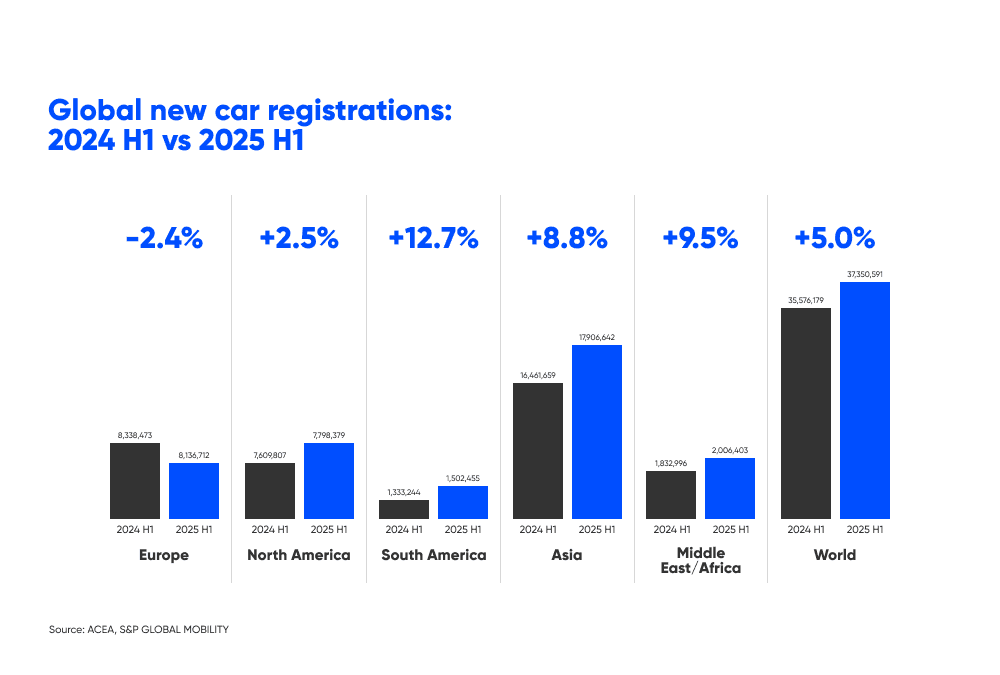
This points to which markets may be the center of attention in 2026 too.
Europe lagged behind in this case. Overall registrations fell 2.4%, and the EU market slipped 1.9%, even though Türkiye, the EFTA countries, and the UK helped soften the decline. Meanwhile, in the US, there was a slight growth of 2.5%.
Looking at the car brands by unit sales, Visual Capitalist’s 2025 analysis found these as top ones:
Toyota: 4.7 million vehicles
Volkswagen: 2.3 million
Ford: 2.0 million
However, it’s important to note the rise of Chinese manufacturers, especially in light of the EV boom. They’re expanding fast – both at home and abroad. In fact, BYD recorded the fastest year-over-year growth among major automakers (+30%).
EV adoption keeps rising even as incentives fade
Here’s where the numbers accelerate and prove how EVs are taking over the world.
Last year, the International Energy Agency (IEA) predicted global electric car sales to surpass 20 million in 2025, accounting for over 25% of all cars sold worldwide. In just the first three months of 2025, global EV sales jumped 35% year-on-year.
While the annual results are yet to be concluded, China, Europe, and the United States remain the core EV markets.
Average EV battery range grew in 2025 and is set to rise in 2026
Range anxiety seems to be fading.
Motorwatt points out that the average EV range has climbed past 300 miles (483 km), up significantly from around 250 miles (402 km) just two years ago. SMMT’s latest data confirms this – the average range of a new electric car on sale in the UK today is almost 300 miles too.
Even though the average EV range is now solid for everyday driving, cars like the Lucid Air prove 400+ miles (644+ km) is already possible. In 2026, more brands will likely catch up mainly through better efficiency (aero, weight, power electronics, thermal management), not just bigger batteries, bringing mainstream models closer to those long-range benchmarks.
Charging infrastructure expands moving into 2026
Infrastructure is improving, but unevenly across regions.
- By the end of Q2 2025, EV boosters reports that Europe surpassed a milestone of more than 1.05 million publicly accessible charging points in Q2 2025, up from about 1 million at the end of Q1. With regulations like the Alternative Fuels Infrastructure Regulation (AFIR) kicking in, expansion is expected to continue through 2026.
- In the US, Reuters-cited Government Accountability Office data puts the country at around 219,000 public charging ports as of April 2025.
- In South America, charging infrastructure growth remains uneven but is clearly accelerating in leading markets: Brazil reached 16,880 public and semi-public charging points by August 2025, marking 14% growth since February 2025.
- In China, expansion is happening at a vastly larger scale – by October 2025, the country had 18.65 million charging points. This represents 54% year-over-year growth, driven by both rapid public network buildout and even faster growth in private chargers. This reinforced China’s global lead heading into 2026.
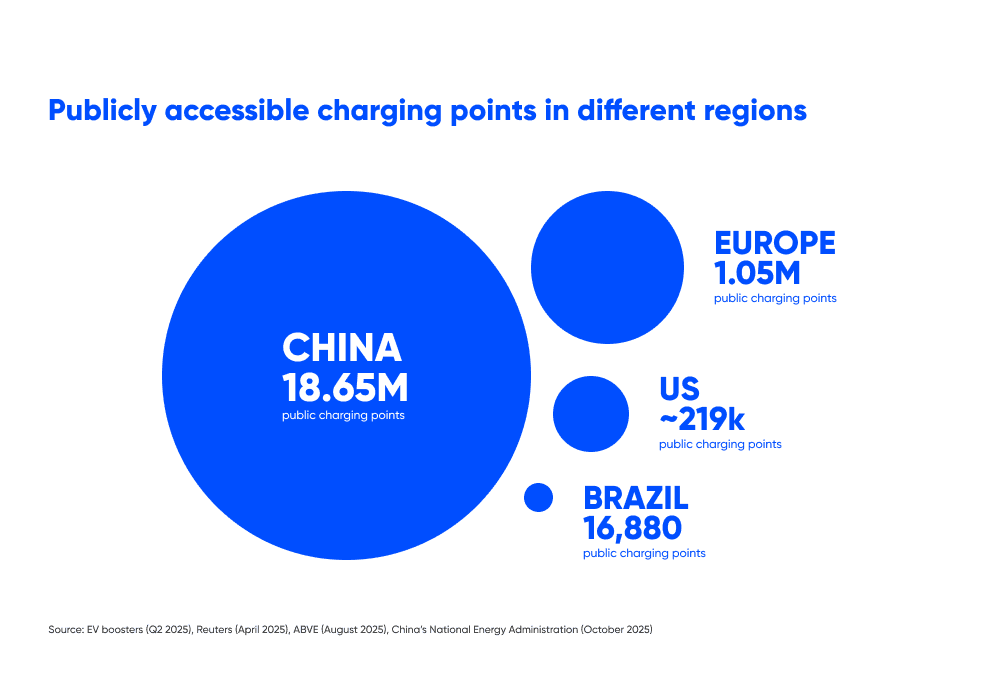
Note: The figures above exclude home charging, which is where a large share of EV charging actually happens.
Key EV incentives and regulation shaping 2026
By 2026, policy frameworks are doing more of the heavy lifting than direct purchase subsidies, with most regions shifting from encouraging adoption to enforcing it.
Here’s how these changes look across the world:
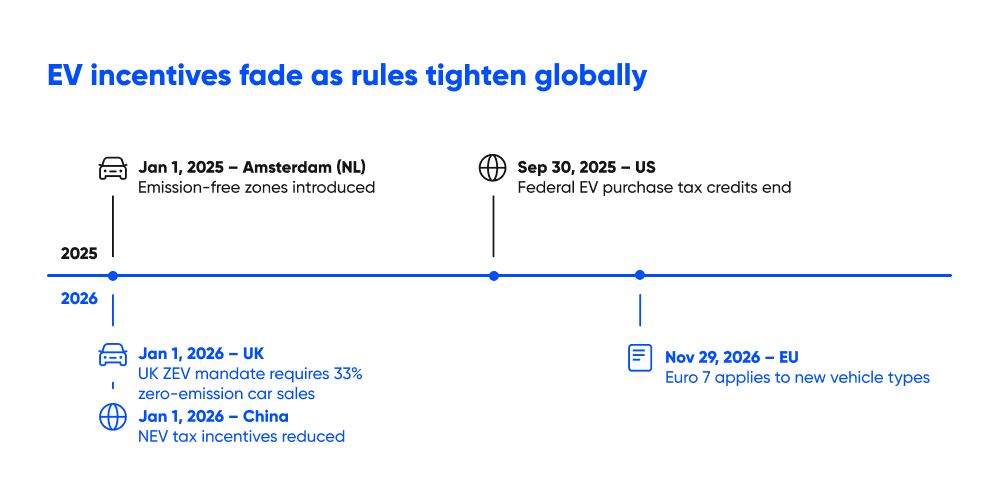
- United States: Federal EV purchase credits end for vehicles bought after September 30, 2025.
- United Kingdom: The ZEV mandate tightens in 2026, requiring 33% of new cars and 24% of new vans to be zero-emission.
- European Union: Euro 7 starts applying to new vehicle types from November 29, 2026. CO₂ compliance is averaged across 2025–2027, smoothing the ramp-up for manufacturers.
- China: NEV purchase tax relief continues in 2026, but at a lower level. The tax benefit is halved and capped at 15,000 yuan per vehicle.

Used car market trends 2025: Expensive, risky, and still in demand
The used market remains massive, but the used car prices aren’t coming down.
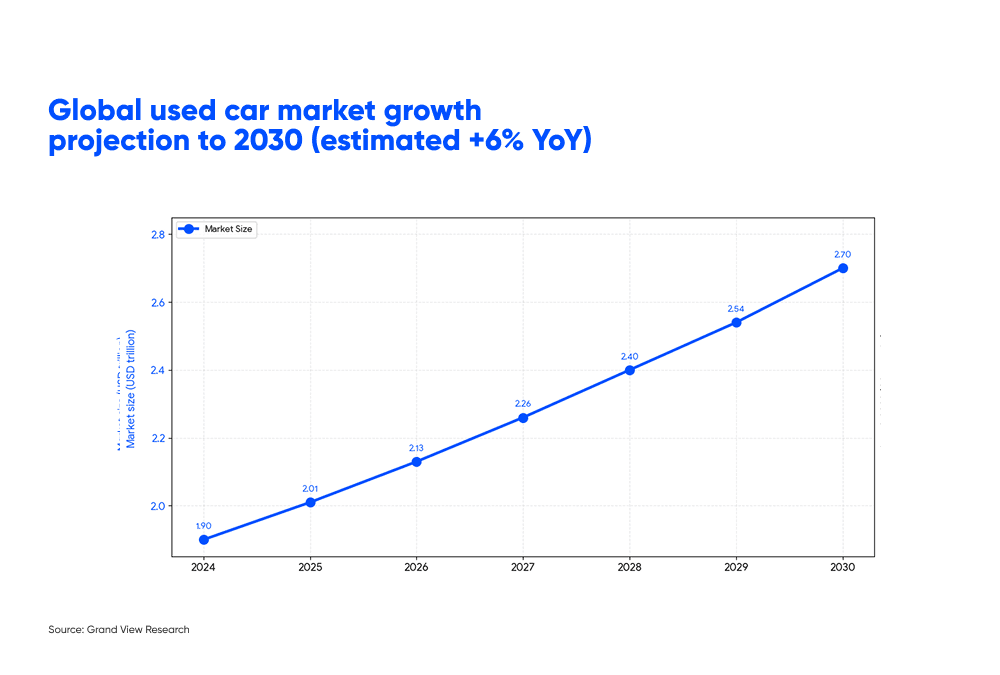
- Grand View Research projects the global used car market to reach USD 2.70 trillion by 2030, growing at a 6.0% per year from 2025 onward. If that growth is smooth, the market size in 2026 lands around USD 2.14 trillion.
- In Europe, this momentum is already visible. Autovista24 reports growth in used-car transactions across Spain, Italy, the UK, Germany, and France in Q3 2025.
- Before the pandemic, the average price of a 3-year-old vehicle hovered just above $22,000. But in 2025, it’s over $31,000. And according to Edmunds, that price may soon look cheap.
- Supply chain disruptions in new car production and increased competition from rental fleets are some of the reasons.
Odometer fraud: Still a big used-market risk
Mileage rollbacks are still a problem in 2025 and will be in 2026 if nothing changes.
Private-sector data suggests the problem remains widespread and has been rising in recent years:
In Europe, the scale is even broader.
- 60+ million used cars are sold annually in the EU, a letter to European Comission by Liesbet Sommen states.
- 5%–12% of domestic used cars show mileage manipulation, while 30%–50% of cross-border sales are affected.
However, odometer fraud still seems to be a criminal offence in only six EU Member States, meaning people still have to protect themselves using their own means.
In 2025, the most reliable ways to spot odometer fraud include checking digital service records, connected-car data, and mileage stored inside the car itself.
One of the easiest options is OBDeleven’s Mileage check, which reads mileage from multiple control units and flags inconsistencies – helping you spot rollback risks before you buy right in the app.
Demand heats up for 3–7-year-old vehicles as supply cools
Buyers still want nearly new cars. They just can’t find enough of them.
- In the US, Edmunds reports the average price of a three-year-old car hit $31,067, and the average time to sell rose to 41 days in Q3 2025.
- The problem is supply. Edmunds says there are only two million three-year-old lease returns expected in 2025, versus about four million a year in the late 2010s.
In Europe, demand skews older. A chart from Indicata’s 2025 report shows that in January, three to four-year-old cars made up 24.34% of used sales, while five-plus-year-old cars made up 42.12%.
For 2026, this points to longer ownership cycles on both sides of the Atlantic.
Vehicle maintenance costs and DIY diagnostics
Keeping cars longer costs more money in 2025.
- In the US, AAA’s 2025 study shows maintenance, repairs, and tires average 11.04¢ per mile, or about $1,656 per year at 15,000 miles.
- In the UK, The Car Expert’s 2025 analysis estimates that gasoline, diesel, and hybrid cars cost an average of £757 per year to service during their first three years, compared with £545 per year for EVs.
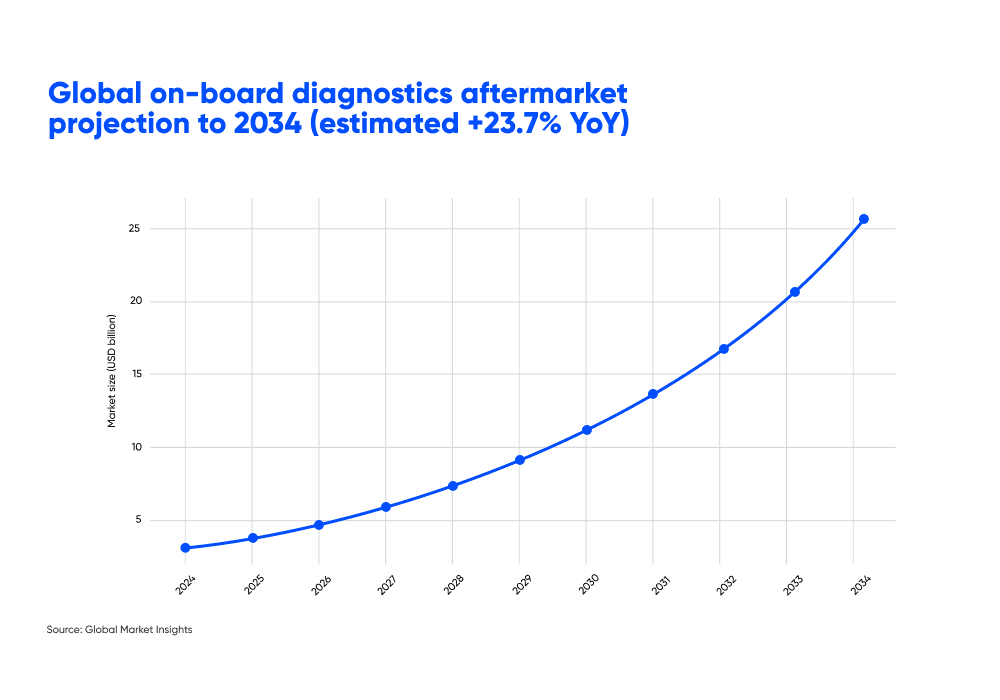
At the same time, DIY diagnostics market is growing, indicating more drivers diagnose issues themselves before visiting workshops.
The global on-board diagnostics aftermarket was valued at USD 3.1 billion in 2024 and is forecast to grow at 23.7% annually through 2034 (Global Market Insights).

Automotive software and connectivity in 2025 and 2026
Cars are increasingly becoming software platforms, with manufacturers using over-the-air (OTA) updates to fix issues and roll out improvements and new features.
- In the 2025 Software-Defined Vehicle Survey 67% of automotive professionals said OTA updates are already deployed, 23% use OTA for feature/capability upgrades today, and 78% expect broader deployment by 2026–2027 (Nasdaq, research by Wards Intelligence/Omdia and sponsored by Sonatus).
- This shift also shows up in the cabin: Grand View Research projects the global automotive infotainment market will grow from USD 14.99B (2023) to USD 28.93B (2030) at a 9.9% CAGR, with Asia Pacific leading share.
Android Auto and Apple CarPlay adoption
Adoption of projection platforms is also already mainstream and shows no signs of stopping in 2026.
- Android Auto is supported in nearly all new cars, with Google reporting that over 250 million cars on the road using it in 2025, up 50 million in roughly a year.
- Apple CarPlay is now supported by 98% of new cars sold in the US and is used over 600 million times per day.
Autonomous driving and ADAS see cautious progress
People are still reluctant towards autonomous driving. AAA’s 2025 survey found only 13% of US drivers trust riding in a self-driving vehicle, while about 60% still feel afraid.
Meanwhile, advanced driver assistance systems (ADAS), such as lane departure warning and pedestrian detection, are becoming the new normal. Demand for it is strong: AutoPacific reports 43% of new-vehicle buyers rank hands-free highway driving as a top desired feature.
Regulation is pushing adoption, especially in the EU, while US regulators continue scrutinizing hands-free systems.
For 2026, we may expect more hands-free highway driving (Level 2+) across more trims and brands, while true eyes-off (Level 3) is likely to remain limited and controversial.
Car ownership behavior moving into 2026
Cars are staying on the road longer.
- In the US, the average vehicle age reached 12.8 years in 2025 and is expected to approach 13 years in 2026 (S&P Global Mobility, CCC).
- In the EU, the average passenger car age is similar – around 12.3 years according to 2024 ACEA report.
- Leasing rebounded to ~15% of US new-vehicle transactions in Q3 2025, JMA group’s report shows – the highest since May of 2021.
Rise of digital car management habits
Car ownership is no longer just about driving. It’s about software, apps and unlocking features through subscriptions. And getting over-the-air (OTA) updates without visiting a workshop.
But not everyone’s cheering for the car as a service shift and most likely won’t in 2026.
- S&P Global Mobility’s 2025 Connected Car Study shows willingness to pay for connected services dropped to 68% in 2025, down from 86% in 2024.
- The share of global respondents who don’t subscribe to any connected services rose 5% vs 2024, with cost as the top reason.
Here’s the deal: Original equipment manufacturers (OEMs) often soften the blow with a free trial. But once it ends, many drivers don’t convert.
Environmental and emissions laws tighten worldwide in 2025 and 2026
In 2025, tighter emissions enforcement was actively spreading.
- In Europe, the European Commission proposed updates to periodic and roadside inspections – including new NOx and ultrafine particle testing and remote-sensing-style measurements to catch high emitters and tampering.
- Across Europe, Low Emission Zones (LEZs) and emerging Zero Emission Zones (ZEZs) came into force or were strengthened in various cities in 2025.
- In the US, the Environmental Protection Agency (EPA) proposed tailpipe standards for model years 2027–2032, but could be delayed.
- In China, regulators are signaling the next wave too, with work accelerating on a “China VII/7” framework in 2025.
Looking into 2026, this trend will continue when initiatives such as Euro 7 start applying and low emission zones continue expanding.
But buyers aren’t universally on board with the pace. 50% of global buyers said they still plan to choose an internal combustion engine (ICE) vehicle within the next 24 months, up 13 points from 2024, per EY’s 2025 Mobility Consumer Index coverage.
What this means for the 2026 automotive market
In 2026, 2025’s trends are likely to intensify.
Growth will probably stay strongest in Asia and emerging markets while Europe lags. EV share should keep rising as range improves and charging expands, but unevenly – and policy will keep replacing discounts.
Used cars are likely to stay pricey due to tight supply, and odometer fraud will keep buyer checks essential. Cars should remain on the road longer, pushing up maintenance needs and DIY diagnostics. Software will keep spreading via OTA updates, infotainment, and phone projection, even as users have no appetite for more subscriptions.
Overall, 2026 looks more like transition than reset. These are signals, not guarantees – we’ll see how it actually plays out this year.