#Automobilindustrie
How to pass an emissions test: 6 pro tips for drivers


TL;DR: Most failures happen because the ECU hasn’t finished its internal tests. Make sure all emissions monitors are complete and not failing by using OBDeleven’s Emissions readiness check.
An emissions test is often a part of a routine inspection which checks whether your car’s engine and pollution-control systems are working correctly.
Modern cars run internal tests called readiness monitors. If too many monitors show “Not ready”, inspection centers can automatically reject the vehicle. You can get rejected for simple but invisible issues: incomplete readiness monitors, active fault codes, small EVAP leaks (like a loose gas cap), or a drive cycle that never completed.
In this article, we’ll give you tips on how to pass emissions test and walk you through the most common reasons cars fail.
What’s an emissions test?
Emissions tests, sometimes called smog tests, measure how cleanly your car runs and whether its systems can properly monitor pollutants. Most states require vehicles to pass emissions tests as part of the registration or inspection process.
During the emissions test, the inspection center will scan your car’s internal emissions monitors, their status, and output. Countries have different requirements and procedures for emissions testing, so it’s important to check your local regulations.
Depending on the region you’re in, the test may check gases like CO₂, hydrocarbons (HC), carbon monoxide (CO), and nitrogen oxides (NOx), along with other emissions-related data.
Pre-emissions test checklist: Quick guide
Here’s a shortlist of the main things to check or fix to ensure a pass on the emissions test.
| Step | How to do it | Why it matters |
| Run an Emissions readiness check | Plug in an OBD device to your car's OBD2 port, connect your vehicle, and run the check on the app | Test results will immediately show if you're ready for the test or what steps you should take to pass |
| Run a diagnostic scan | With the OBD device still plugged in, run a scan on your car to see all active fault codes | Scan results will let you see which systems need fixing; you'll be able to clear fault codes |
| Complete a full drive cycle | Drive in various conditions with optimal engine temperature | It helps the ECU run and complete internal tests for all emissions monitors |
| Don't keep a full tank | Don't refuel fully before the test; make sure the gas tank isn't empty | Helps the fuel settle and ensures stable fuel trims |
| Warm up the engine | Before the test, reach full coolant operating temperature | Cold engines usually produce more emissions |
What are readiness monitors and why do they matter?
Readiness monitors are self-tests your engine control unit (ECU) runs independently to verify that emissions-related components are working correctly.
Key readiness monitors are:
| Readiness monitor | Description |
| Catalyst | Checks the catalytic converter efficiency |
| Oxygen sensors | Ensures air and fuel mixture is correct |
| Fuel system | Monitors fuel trims and injector performance |
| NOx/SCR system | Checks NOx reduction (in diesel vehicles) |
| DPF/PM filter | Checks soot filter performance (in diesel vehicles) |
If any monitor hasn’t completed its required self-test yet, the ECU reports it as “Not ready.” So, when an inspector plugs in their tester, they’re simply reading the ECU’s own status:
- “Ready” = the system has completed its self-test
- “Not ready” = the ECU hasn’t finished testing that system or testing couldn’t be completed because of an issue
These tests only run while you drive under specific conditions, like enough highway time, a cold start, steady cruising, proper engine temperature, and no active faults.
Tip: If ECU returns “Ready,” it doesn’t mean there are no issues – it only indicates the test is completed. To check for actual faults, run an Emissions readiness check and a diagnostic scan with an OBD scanner. You’ll find a step-by-step on how to do it below.
“Not ready” usually happens after clearing codes, disconnecting the battery, fixing parts without driving long enough after, or doing only short trips. However, it can also indicate ECU problems.
Why “Not ready” can cause an automatic fail
Many inspection centers (TÜV in Germany, revisioni in Italy, and most US state programs) will reject a car if certain monitors haven’t completed.
Because the ECU hasn’t finished its internal checks, the inspector testing your car sees “Not ready”. Even though your car might run fine and technically be in perfect shape, it can signal actual issues for the inspector. If your car fails, it must be retested after the issues are resolved.
Why monitors don’t complete
There can be multiple reasons why certain emissions monitors don’t complete before your emissions test. Here’s a short list of the most common reasons:
- You recently cleared fault codes or performed a reset of the ECU or emission monitors
- There was a sudden power loss (e.g., battery disconnected), which can also trigger a reset and require a second attempt at completing the drive cycle
- You only drove short distances for a while, and the engine never reached optimal temperature
- A component is faulty and prevents the monitor from completing
Pro tip: Follow a simple rule of thumb to help tests complete – start cold, let the temperature gauge reach its normal middle position, then drive for another 20-30 minutes. Make sure you’re cruising, accelerating, and breaking during the drive.
How to check emissions readiness at home
Emissions tests are usually included in periodic vehicle inspections, so you will typically need to pay a fee. To avoid extra costs, perform a diagnostic scan and an Emissions readiness check at home beforehand.
OBDeleven app has a dedicated Emissions readiness check feature that reads emission-related data and provides results about engine health and specific emissions monitors.
All you need to do is plug the OBDeleven 3 device into your car’s OBD port, connect your vehicle, and run the test via app.

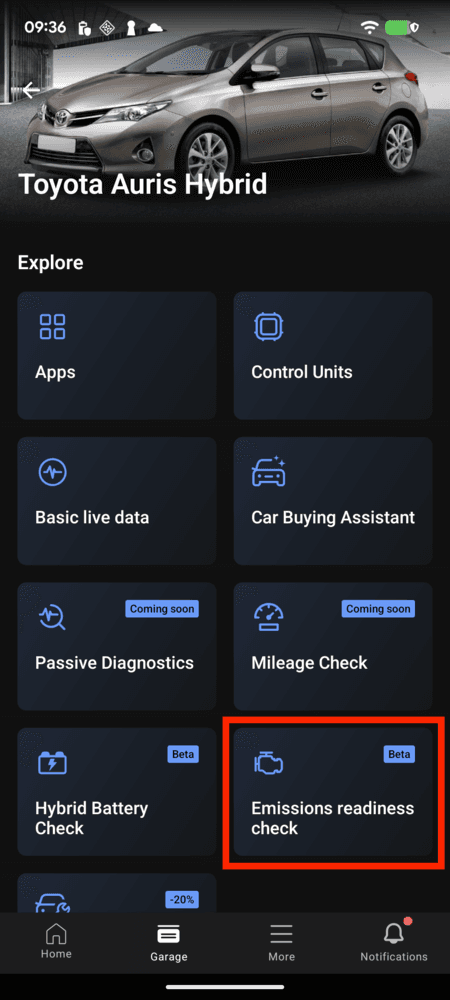

What data you’ll see after running Emissions readiness check:
- A full list of emissions monitors marked “Ready” or “Not ready”
- Active emissions-related faults
- Warm-ups since last fault clear
- Distance driven since clearing codes (important if some are “Not ready”)
- System-specific readiness (catalyst, O2, EVAP, SCR, PM filter, and more)
Can I pass the emissions test with check engine light on?
Short answer – no.
A lit check engine light means the ECU has detected a problem that can affect your emissions readings.
Most inspection centers automatically fail any vehicle with the check engine (also known as Malfunction Indicator Light or MIL) illuminated, since it indicates an engine or emissions system issue.
The best approach is to diagnose and repair the reason for a check engine light, clear the fault code, and then use an OBD tool to verify that your vehicle systems are working properly before going to your smog test.
If you didn’t pass the test, don’t worry. You can usually keep driving after a failed test because the inspection doesn’t disable the car. However, you will need to fix the issue and pass a retest before your registration expires or before the allowed grace period runs out.
Each region sets its own rules, but the idea is the same: you can drive for now, just not indefinitely.
Pro tips on how to pass emissions test
There are multiple ways to prepare for an emissions test without paying a fortune or having to go to the inspection center. Proper maintenance is essential to ensure your vehicle is in optimal condition and ready to pass the emissions test.
1. Complete a proper drive cycle
The ECU might not be able to reach the conditions to complete readiness tests if you only drive short distances. To avoid that, complete a full drive cycle:
- Start cold
- Reach full engine temperature (approximately 70-105ºC or 160-220ºF)
- Drive enough distance (approximately 50-100 km or 30-60 miles)
- Do stop-and-go driving
- Drive in a highway
- Actively use brakes
- Accelerate fully without braking
After the drive cycle, run Emissions readiness check with OBDeleven 3 to see if all monitors were able to complete.
2. Fix active fault codes
Run a full diagnostic scan on your car to see what faults are present and fix them.
Always follow the manufacturer's recommended procedures for diagnosing and repairing emissions equipment to ensure your vehicle meets compliance standards and passes the emissions test.
Tip: If you clear the codes, don't forget to complete a full drive cycle, so the ECU can re-test the systems.
3. Check the gas cap and EVAP system
EVAP system faults are one of the most common reasons why cars fail emissions tests.
Most EVAP codes come from loose gas caps, cracked rubber, stuck purge valves, or faulty pressure sensors within the emissions systems.
Here’s how to easily fix some EVAP faults:
- Make sure the gas cap clicks several times
- Inspect the rubber gasket; if it’s cracked, dried, or torn, replace the cap
- Keep the fuel tank between 25–75 percent for emissions tests
- Clear the fault after fixing and run a proper drive cycle again
4. Warm up your engine before the test
Let your vehicle’s engine reach a full operating temperature before going for your smog test. This is especially important if you’re in Europe where test centers run tailpipe tests on some vehicles.
Before the actual test, allow your car to idle for a few minutes and then drive for a bit to ensure all emissions systems are properly tested and warmed up.
5. Keep the tank 25-75% full
Keep the gas tank between 25 and 75 percent and give the engine a bit of driving time before the emissions test, so everything settles. Avoid last-minute refueling, so the fuel trims are stable.
6. Use quality fuel
Always use good quality fuel to ensure your car runs clean. If your car feels slightly rough because of dirty injectors, a fuel additive can act as a fuel system cleaner and remove minor deposits, especially if you mostly drive short trips.
Just keep expectations realistic – an additive can smooth things out short term, but it will not fix deeper issues or dramatically change your emissions.
Pass an emissions test with OBDeleven 3
While there are many reasons for a failed emissions test, passing it boils down to ensuring three things:
- Faults are fixed
- Readiness monitors are complete
- You know your emissions readings before the smog test
Instead of guessing, use OBDeleven’s Emissions readiness check to get a clear, visual overview of your car’s emission status. It shows what is ready, what is not, and what you need to fix or drive more before booking your inspection.

